

What Works Better Between Contact Lenses and Keratoconus Treatment in Mumbai
Living with keratoconus can affect much more than simply how clearly a person sees. As the cornea gradually becomes thinner and more irregular, everyday activities such as reading, driving, using digital screens, recognizing faces, or seeing clearly at night may become increasingly challenging. Blurred or distorted vision, glare, halos around lights, sensitivity to bright light, and frequent changes in glasses prescriptions are some of the common difficulties patients may experience. The condition can also progress differently from one person to another, making regular corneal evaluation an important part of long-term eye care.
For someone considering Keratoconus Treatment in Mumbai, an important question is whether specialized contact lenses are enough or whether a treatment aimed at managing the underlying corneal condition may be more appropriate. These options should not be viewed as doing the same job. Specialized contact lenses can help create a smoother optical surface over an irregular cornea, often improving the quality and sharpness of vision. Treatments such as corneal cross-linking, on the other hand, are intended to strengthen the corneal structure and may be considered when there are signs of progression. The most suitable approach depends on factors such as the shape and thickness of the cornea, the severity and progression of keratoconus, the patient’s visual needs, and how well their vision can be managed with glasses or contact lenses. A detailed corneal assessment is therefore essential before deciding which option is appropriate.
What Is Keratoconus?
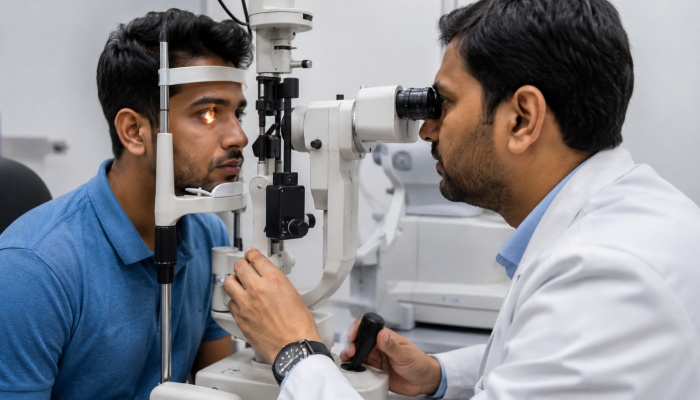
Keratoconus is a condition in which the cornea, the clear front surface of the eye, gradually becomes thinner and changes from its normal rounded shape. Instead of remaining relatively smooth and dome-shaped, the cornea can become more cone-like and irregular.
Because the cornea plays an important role in focusing light, these changes can affect the quality of vision. A person may experience:
- Blurred or distorted vision
- Increasing astigmatism
- Frequent changes in glasses prescription
- Difficulty seeing clearly at night
- Increased sensitivity to glare
- Halos around lights
- Difficulty achieving clear vision with ordinary glasses
Keratoconus can behave differently from one person to another. In some people, the condition remains relatively stable, while in others, it may progress over time. This is why regular eye examinations and appropriate corneal assessment are important.
Can Contact Lenses Treat Keratoconus?
Contact lenses can be extremely useful for improving vision in people with keratoconus, but they do not generally correct the underlying structural weakness of the cornea.
Specialized lenses can create a more regular optical surface in front of an irregular cornea. Depending on the patient’s condition, an eye-care professional may consider options such as rigid gas-permeable lenses, hybrid lenses, scleral lenses, or other specialized designs.
The purpose is primarily to provide better visual quality when ordinary spectacles are no longer sufficient.
This distinction is important. A person may see much more clearly while wearing a specialized contact lens, but improved vision does not necessarily mean that the underlying corneal condition has stopped progressing.
What Do Contact Lenses Actually Do?
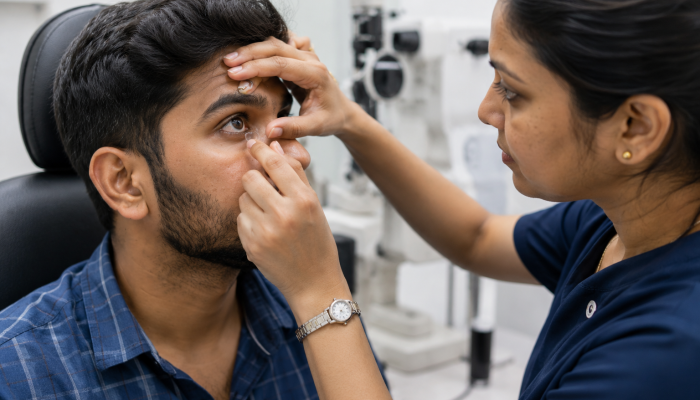
The main benefit of specialized contact lenses is optical correction.
In keratoconus, the irregular corneal surface can scatter light and prevent it from focusing properly on the retina. A suitably fitted lens can help create a smoother optical surface, allowing light to enter the eye more regularly.
Depending on the type of lens, benefits may include:
- Better visual clarity
- Reduced visual distortion
- Improved ability to perform daily activities
- Better vision when spectacles are insufficient
- In some cases, greater comfort than expected from older lens designs
However, contact lenses require proper fitting and follow-up. A lens that does not fit correctly may be uncomfortable or may cause problems for the cornea.
What Does Medical Treatment Aim to Achieve?
Medical treatment for keratoconus can have a different objective from contact lens correction.
One important treatment is corneal cross-linking. It is designed to strengthen the corneal tissue and is commonly considered when examinations indicate that the condition is progressing.
The basic principle is to use riboflavin, commonly known as vitamin B2, together with controlled ultraviolet-A light to encourage additional bonding within the corneal collagen. This can increase the biomechanical strength of the cornea.
The aim is not simply to make the patient see clearly immediately. Instead, the objective is to help stabilize the cornea and reduce the risk of further progression in suitable patients.
That is why comparing contact lenses and medical treatment as if they perform the same job can be misleading.
Contact Lenses vs Medical Treatment
The simplest way to understand the difference is to look at what each approach is designed to accomplish.
Factor | Contact Lenses | Medical Treatment |
Main purpose | Improve the quality of vision | Address the underlying corneal condition when appropriate |
Effect on vision | Can provide significant visual improvement | Visual improvement varies according to the treatment and corneal condition |
Effect on progression | Does not generally stop progression | Some treatments are intended to stabilise progressive disease |
Suitability | Depends on corneal shape, vision and lens tolerance | Depends on progression, corneal thickness and clinical findings |
Typical role | Vision rehabilitation | Disease management or structural treatment |
Long-term considerations | Requires ongoing lens care and monitoring | Requires appropriate assessment and follow-up |
The two approaches are therefore not necessarily competitors. In some patients, they can form different parts of the overall management plan.
For example, a patient may undergo a treatment intended to stabilize the cornea and may still need specialized contact lenses to achieve the best possible vision afterward.
When Are Contact Lenses a Good Option?
Contact lenses may be considered when a person’s main problem is reduced visual quality caused by corneal irregularity and the cornea can be fitted safely.
They can be particularly helpful when:
- Glasses no longer provide satisfactory vision.
- The patient has significant irregular astigmatism.
- The corneal shape allows safe lens fitting.
- The patient can handle and care for the lenses properly.
- There is no immediate indication for another intervention.
A Keratoconus Specialist in Mumbai can assess the corneal shape, vision and other clinical factors before recommending the most suitable approach.
Contact lens fitting should not be treated as a one-time process. The cornea can change over time, and the lens that works well today may require adjustment later.
When Might Additional Treatment Be Needed?
Additional treatment may be considered when there is evidence that keratoconus is progressing or when the condition has become too advanced for satisfactory management with glasses or contact lenses alone.
Signs that may prompt further assessment include:
- Repeated changes in refraction
- Increasing corneal steepness
- Changes seen on corneal topography or tomography
- Progressive thinning
- Declining visual quality
- Increasing difficulty with contact lenses
The exact decision requires clinical evaluation rather than relying on symptoms alone.
A patient who has good vision with contact lenses may still need monitoring because comfortable and clear vision does not necessarily tell us whether the cornea itself is stable.
Understanding Corneal Cross-Linking

Corneal cross-linking is commonly discussed when keratoconus is showing signs of progression.
During the procedure, the cornea is prepared, and riboflavin is used along with controlled ultraviolet-A exposure. The process is intended to strengthen the collagen structure of the cornea.
The treatment is generally aimed at stabilization rather than providing an instant replacement for glasses or contact lenses.
After treatment, some patients may continue to use glasses or specialized contact lenses. The need for additional vision correction depends on the condition of the cornea and the individual’s visual requirements.
A Keratoconus Surgeon in Mumbai can determine whether a patient may be suitable for a particular procedure after evaluating the corneal measurements and other relevant factors.
What Happens in More Advanced Keratoconus?
As keratoconus becomes more advanced, managing vision can become increasingly challenging.
Some people may continue to achieve useful vision with specialized contact lenses. Others may develop significant corneal scarring, severe irregularity, poor lens tolerance, or other problems that make conventional management difficult.
In selected advanced cases, surgical procedures may be discussed. However, surgery is not automatically required simply because someone has keratoconus.
The type of procedure, if any, depends on factors such as corneal shape, thickness, scarring, visual function, disease progression and previous treatment.
Keratoconus Surgery in Mumbai should therefore be considered as part of an individualized treatment decision rather than as a universal solution for everyone with the condition.
Can Keratoconus Be Managed Without Surgery?
Yes, some people can manage keratoconus without surgery, particularly when the condition is stable and useful vision can be achieved with glasses or specialized contact lenses.
However, avoiding surgery should not be confused with avoiding medical monitoring.
Regular examinations can help determine whether the cornea remains stable. If progression is detected, treatment may be considered before the condition becomes more difficult to manage.
This is one reason early assessment can be valuable. Detecting changes at an earlier stage may provide more options for management.
Why Early Diagnosis Matters
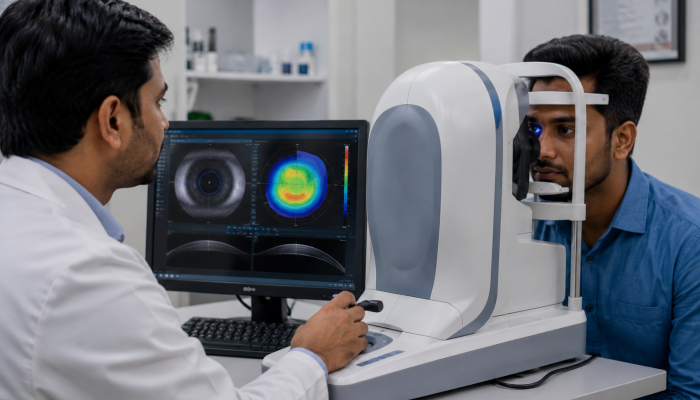
Keratoconus often begins at a younger age, although its course varies.
Early diagnosis allows an ophthalmologist to establish baseline measurements and monitor changes over time. Tests such as corneal topography and tomography can provide detailed information about the shape and structure of the cornea.
This information can be more useful than symptoms alone.
For example, a patient may feel that their vision has remained unchanged while measurements show subtle changes in corneal shape. Conversely, visual symptoms may be significant even when the disease is relatively stable.
Regular monitoring helps bring these different pieces of information together.
How Is the Right Option Decided?
There is no single treatment that is best for every person with keratoconus.
An eye specialist may consider:
- The patient’s age
- Current visual quality
- Corneal shape
- Corneal thickness
- Evidence of progression
- Degree of irregular astigmatism
- Contact lens tolerance
- Presence of corneal scarring
- Previous treatments
- The patient’s daily visual needs
A comprehensive examination helps determine whether the immediate goal should be vision correction, disease stabilization, or management of a more advanced corneal problem.
A Keratoconus Treatment Center in Santacruz, Mumbai can provide an appropriate setting for detailed assessment and discussion of available management options.
It is also important for patients to understand that treatment decisions can change over time. A person who needs only vision correction today may require a different approach later if the cornea begins to progress.
Is One Better Than the Other?
The answer depends on what problem needs to be addressed.
If the main concern is blurred or distorted vision caused by an irregular corneal surface, a properly fitted contact lens may provide substantial visual improvement.
If examinations show progressive changes in the cornea, a treatment designed to stabilize the condition may become important.
In some situations, both approaches may have a role. Treatment may focus on stabilizing the cornea while contact lenses continue to provide the visual correction needed for daily life.
Therefore, the better question is not simply “Which is better?” It is “What does this particular cornea need right now?”
Professional Experience and Patient-Centred Care
Dr. Vinay Agrawal developed his ophthalmic expertise through formal medical education and a focused interest in disorders affecting the optical system of the eye. After graduating from T.N. Medical College in Bombay, he pursued a Master’s degree in Ophthalmology. He subsequently received the Diplomate of the National Board (D.N.B.) qualification from the National Board of Examinations, Ministry of Health, in 1991. He completed his Cornea Fellowship from the renowned L.V.Prasad eye institute, under the world renowned Dr. G. N. Rao. His background provides a foundation for evaluating patients with corneal and vision-related concerns.
At Clear Vision Eye Centre, patients can discuss their symptoms, examination findings and available management approaches as part of a structured eye-care assessment.
Key Takeaways
Contact lenses and medical treatments for keratoconus serve different purposes.
The most important points to remember are:
- Specialized contact lenses can improve vision by creating a more regular optical surface.
- Contact lenses do not generally correct the underlying structural weakness of the cornea.
- Corneal cross-linking may be considered when progressive keratoconus is identified.
- Not every patient with keratoconus needs surgery.
- Some patients may benefit from more than one management approach.
- Regular corneal monitoring is important, even when vision seems satisfactory.
- Treatment decisions should be based on detailed clinical examination and corneal measurements.
For patients looking for a Keratoconus Treatment Center in Santacruz, the most useful first step is a comprehensive evaluation rather than choosing a treatment based only on symptoms or someone else’s experience.
Book Your Appointment
If you have keratoconus, frequent prescription changes, worsening visual distortion, or difficulty getting clear vision with glasses or contact lenses, consider arranging a detailed corneal evaluation. Dr. Vinay Agrawal at Clear Vision Eye Centre can assess your corneal condition and help you understand which management options may be appropriate for your individual needs. For patients considering Keratoconus Treatment in Mumbai, an expert evaluation can help identify the right next step based on the condition and progression of the cornea.
Frequently Asked Questions
1. Can contact lenses cure keratoconus?
No. Contact lenses are primarily used to improve visual quality. They can help compensate for the irregular shape of the cornea, but they do not generally cure the underlying condition.
2. Can contact lenses stop keratoconus from progressing?
Contact lenses primarily address vision. They should not be assumed to stop disease progression. Patients with keratoconus should have regular examinations to determine whether the cornea is stable.
3. When is corneal cross-linking considered?
Corneal cross-linking may be considered when clinical evaluation shows that keratoconus is progressing and the patient meets the requirements for the procedure. The decision depends on individual corneal measurements and other clinical factors.
4. Does everyone with keratoconus need surgery?
No. Many patients can be managed with glasses, specialized contact lenses, monitoring, or other appropriate treatments. Surgery is generally considered only when indicated by the patient’s condition.
5. Can keratoconus worsen even if contact lenses provide clear vision?
Yes. Clear vision while wearing contact lenses does not necessarily mean that the underlying cornea is stable. Regular examinations are important to monitor structural changes.
6. How is the right treatment selected?
The decision is based on factors such as corneal shape, thickness, visual function, evidence of progression, contact lens tolerance, age and the overall condition of the eye. A detailed corneal assessment is necessary before selecting a treatment.